The Problem
Many of the most promising inhaled therapeutics — proteins, peptides, amorphous small molecules — are inherently unstable. Proteins denature during the mechanical and thermal stresses of particle engineering. Amorphous drugs recrystallize during storage, changing dissolution behavior and aerosol performance unpredictably. Poorly soluble compounds resist co-formulation with hydrophilic partners.
These stability challenges are not independent of the delivery problem. A drug that recrystallizes loses the dissolution advantage that an amorphous form was designed to provide. A protein that aggregates during spray drying may trigger immunogenicity at the mucosal surface. The solid-state form of a drug — crystalline, amorphous, or something in between — propagates consequences across every downstream domain: stability, dissolution, transport, and biological activity.
Our Approach
We approach particle engineering as a cross-domain design problem. Every material choice — polymer identity, drug-to-excipient ratio, solvent system, drying conditions — propagates consequences across multiple physical domains simultaneously. Our practice is to map these consequences across all relevant domains before making a choice, rather than optimizing one property at a time and discovering failures late.
Amorphous solid dispersions for inhalation. We design spray-dried amorphous systems where polymer selection is guided not just by glass transition temperature, but by the full set of constraints: processing stability (can the shell survive drying without plasticization?), solid-state stability (does the composite Tg provide adequate storage margins?), release kinetics (does dissolution match the therapeutic window?), and barrier interactions (does the polymer help or hinder transport through mucus?).
Multi-component particle architectures. We develop particles where internal spatial distribution is deliberately controlled — core-shell structures, crystalline-in-amorphous composites, and multi-drug particles where each component’s location within the particle is engineered to serve a specific function.
Polymer stabilization of small molecules. We investigate how polymers chemically and physically stabilize labile small molecules against recrystallization, degradation, and moisture-induced transformation — with a focus on understanding the molecular mechanisms of stabilization rather than empirical screening.
Selected Publications
- Dechayont B, Brunaugh AD. Chitosan Stabilizes Curcumin against Hydrolysis and Potentiates Antimicrobial Activity against Pseudomonas aeruginosa in a pH-Dependent Manner. ACS Omega, 2026.
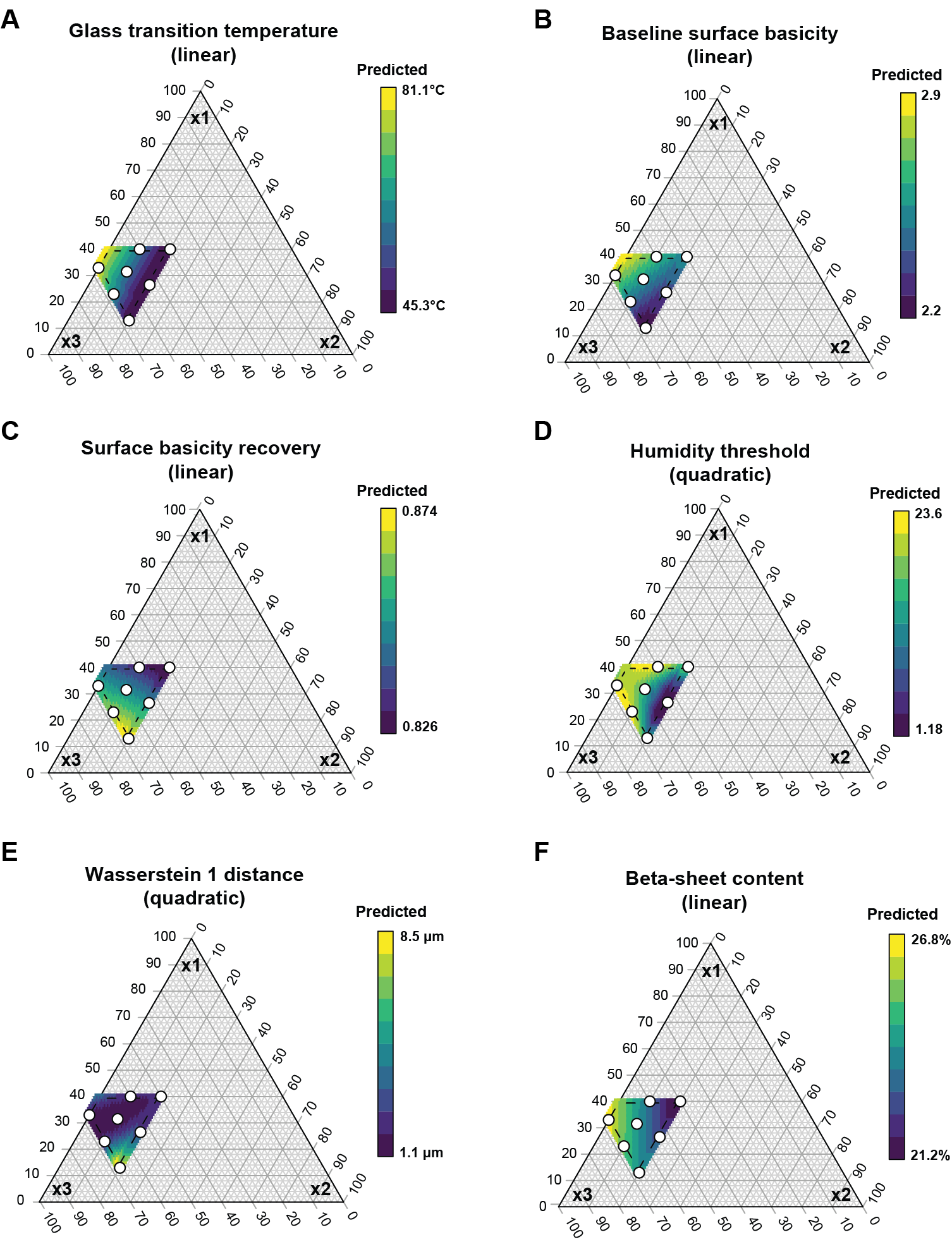
- Xia G, Bennette N, Watts AB, Brunaugh AD. Mapping a Ternary Carbohydrate Design Space for Stable and Dispersible Protein Dry Powders. Molecular Pharmaceutics, 23(7): 3825–3842, 2026.
- Romero-Gonzalez M, Park M, Chen Z, Xia G, Dechayont B, Brunaugh AD. Colistin-Stabilized Antisolvent Precipitation Enables Engineering of Microcrystalline Niclosamide for Inhalable Composite Powders. International Journal of Pharmaceutics, 695: 126791, 2026.
- Romero-Gonzalez M, Crowther J, Ordoubadi M, Brunaugh AD. Strategies to Overcome Undesired Physicochemical Changes in Particle Engineering for Inhalation. KONA Powder and Particle Journal, 42: 121–133, 2025.
- Brunaugh AD, Ding L, Wu T, Schneider M, Khalaf R, Smyth HDC. Identification of Stability Constraints in the Particle Engineering of an Inhaled Monoclonal Antibody Dried Powder. Journal of Pharmaceutical Sciences, 111(2): 403–416, 2022.
- Brunaugh AD, Seo H, Warnken Z, Ding L, Seo SH, Smyth HDC. Development and Evaluation of Inhalable Composite Niclosamide-Lysozyme Particles: A Broad-Spectrum, Patient-Adaptable Treatment for Coronavirus Infections and Sequalae. PLOS ONE, 16(2): e0246803, 2021.
- Brunaugh AD, Wu T, Kanapuram SR, Smyth HDC. Effect of Particle Formation Process on Characteristics and Aerosol Performance of Respirable Protein Powders. Molecular Pharmaceutics, 16(10): 4165–4180, 2019.